

After recent changes in federal tax incentives for solar installations, it has never been more essential for home and business owners to choose their solar providers wisely. Nationwide chains can deliver brand recognition, but a local solar provider offers in-person communication, knowledge of local laws, and experience with the limitations and benefits in their area.
This article details the benefits of choosing a local provider for a new solar array, including factors you can review to find a provider you trust. We’ll also go over solar financing options to help home and business owners prepare for their solar installations with confidence.
Look for Reputable Solar Providers
Even solar providers with impressive reputations may lack experience or qualifications that could make a difference to your project. Consider these factors when choosing a local solar provider:
- Certifications: Certain organizations certify solar providers based on their safety and compliance standards, including the North American Board of Certified Energy Practitioners (NABCEP). Certification is not a requirement to trust a provider, but it can demonstrate the provider’s industry compliance.
- Licensing: Any solar installer serving a local area should be licensed to provide services there.
- Insurance Status: The provider should be properly insured so that any mistakes or accidents during installation are covered by their policy and won’t be the property owner’s responsibility.
- Subcontractor: Whether the provider uses a subcontractor for part or all of the installation process should be clearly communicated. If a subcontractor will be used for any part of the installation, review their credentials along with the solar company’s to verify that they are qualified to complete the project.
- Past Experience: Reputable providers will have a transparent online history, including Google reviews or clearly documented case studies on their website. Particularly for properties with distinct or old buildings, prioritize a provider’s experience in successfully installing solar arrays on similar properties.
Essential Takeaway: These factors provide a framework for home and business owners to evaluate and compare providers before contacting them. Those whose credentials, reputation, and experience appear suitable for the project can proceed to the next step.
Consider the Provider’s Roof Assessment Methods and Results
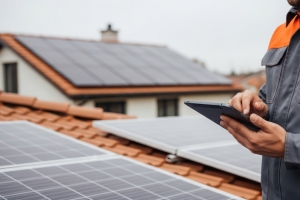
After reviewing the credentials of potential providers, the next step is to schedule a roof assessment. During the assessment, the provider will examine the roof’s structure, orientation, and age to determine the best plan for installing the array. Reputable providers offer in-depth assessments of how vents, roof structures, orientation, sunlight coverage, shade, potential seasonal changes, and material choices will affect the array’s performance.
Prioritize providers that can provide quick, immediate price estimates for the installation to understand your break-even timeline and financial options better. Experienced providers walk property owners through their options, provide transparent communication, and clarify price estimates for each material or design option.
Choose the Right Solar Financing Option
Experienced solar providers offer multiple financing options. The option you choose may change the benefits available to your solar installation later. Review this chart before finalizing your decision:
| Solar Financing Option | Benefits | Drawbacks | Use Case |
| Cash | With cash payments, owners take advantage of local and federal solar incentives, avoid monthly payments, and achieve cost certainty in their new investment. | Cash payments are the most expensive payment method in terms of upfront costs. | Property owners who have the cash can maximize their array’s financial value by owning it outright and using the benefits from day one. |
| Solar Loan | Solar loans allow owners to pay for their arrays in fixed monthly payments, offering cost security with the potential for low or no upfront cost. | Solar loans charge interest, making them more expensive overall than cash payments and extending the financial break-even time. | Loans may be useful for owners who lack the full funds to pay for the array but still want to own the system, take advantage of benefits, and maximize savings. |
| Solar Lease | Solar leases or power purchase agreements (PPAs) allow owners to generate power from a solar array without owning the array. This provides immediate savings by reducing upfront costs and outsourcing system monitoring and maintenance to the lender. | Since the property owner is leasing the solar array, they can’t take advantage of incentives such as SRECs and tax advantages. | Those who want to install a solar system with the least upfront cash can use a solar lease to defer maintenance costs and down payments in exchange for control. |
Providers that offer multiple financing options can walk property owners through the pros and cons of each option in their situation and help them choose the one that maximizes the potential of their new solar array.
Find a Local Solar Provider You Can Trust

At Energy Select, our goal is to help property owners find the best course of action with their new solar array, including the right financing for their situation. Our residential and commercial solar strategies help home and business owners in Maryland reduce costs, access incentives, and meet local regulations. We provide instant quotes following solar panel assessments to help you and your team manage expenses and create an effective financial plan moving forward.
Contact our team today and schedule a solar site assessment to learn more about your options and start saving on your monthly power bills.