

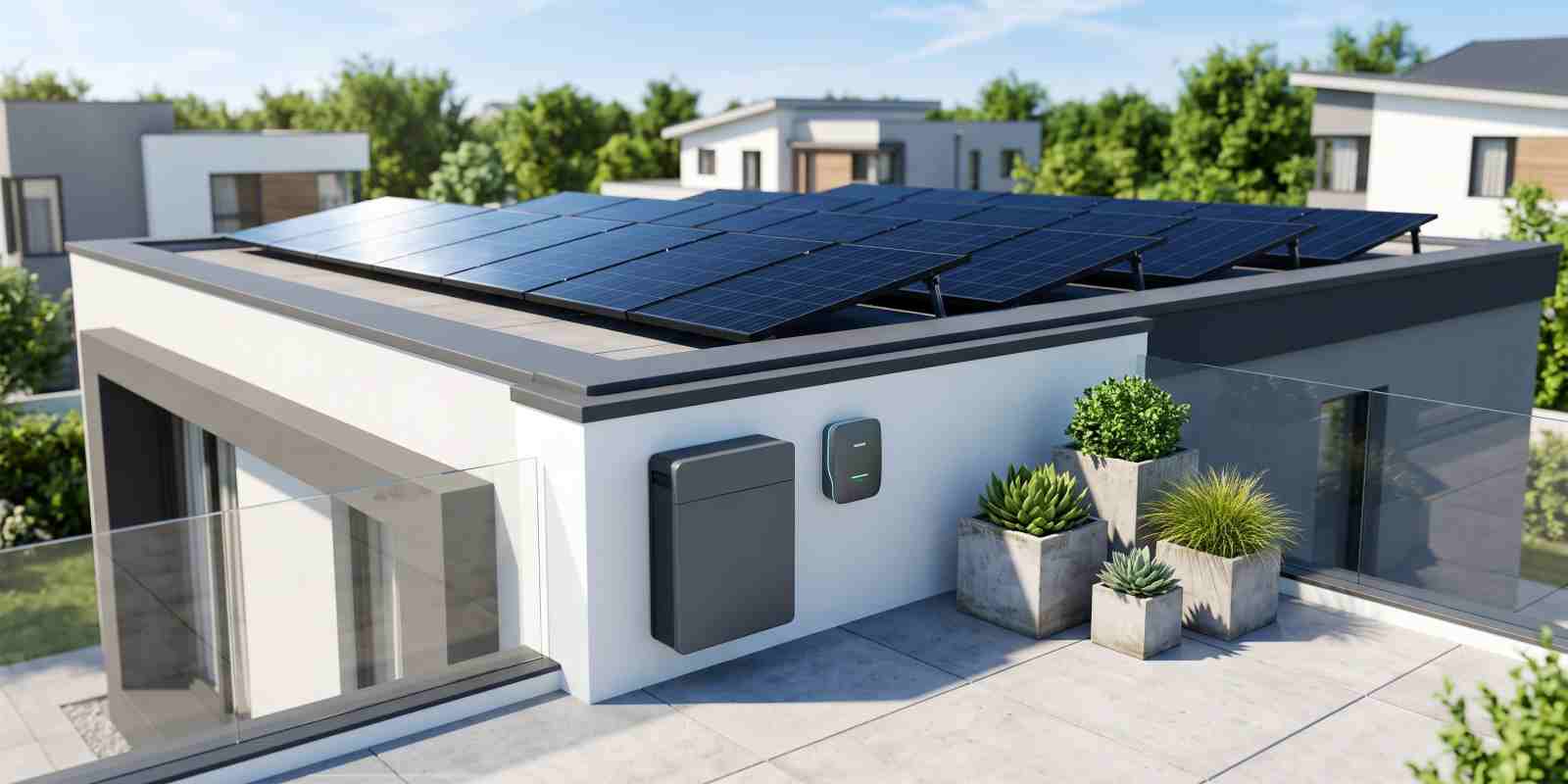
Many homeowners with solar panels in Southern and Western Maryland have experienced a storm that knocks out their power. And for many, that starts a conversation about battery storage.
A solar battery backup strengthens your home’s energy independence by providing more consistent access to power, storing surplus solar energy for use when your panels aren’t producing. Homeowners have a number of storage options, and which is right for you may depend on your exact setup and needs.
Why Grid-Tied Solar Alone Does Not Keep the Lights On
Standard solar systems are tied to the grid in a way that forces them to automatically shut down during a power outage. It’s a safety feature, not a flaw.
When storm damage takes down a power line, crews have to go out and repair it. They can’t have electricity being fed into the lines from residential solar panels. Your power goes out with everyone else’s, even though you have solar panels, in order to keep crews safe while they work on the lines.
What can keep your lights on in a situation like that is a battery backup system with a transfer switch. This isolates your solar setup from the grid and enables your system to keep your power on when the utility lines are damaged.
Maryland’s Battery Storage Grant and Its Current Status
Maryland’s Residential and Commercial Energy Storage Program offers financial support to both residential and commercial energy customers in Maryland who are installing energy storage solutions. The program has a yearly cap that has already been met in 2026. The website states the portal should reopen for 2027 in the coming months.
The program, when available, offers grants equal to 30% of installed battery cost, capped at $5,000 for residential systems.
What Changed With the Federal Tax Credit
The One Big Beautiful Bill Act was signed into law in July of 2025 and eliminated the 30% federal residential clean energy tax credit. Homeowners who concluded their installation and related expenditures before December 31, 2025, could carry forward unused credits, but the credit isn’t available for new residential battery or solar projects.
What Storage Actually Costs
The cost to install battery storage will depend on the brand chosen and its usable capacity, as well as how challenging it is to install. A Tesla Powerwall 3, one of the more common systems installed today, runs close to $1,000 per installed kilowatt-hour, and a full system is typically around $13,000 or more before any incentives, according to EnergySage marketplace data (prices subject to change).
Batteries from other manufacturers typically fall in a similar range per kilowatt-hour. The final number for a specific home depends on how many hours of backup are needed, whether the battery is being added to an existing solar system or installed alongside a new one, and whether the home’s electrical panel needs upgrades to support it.
A qualified installer can give an accurate figure after reviewing actual usage data and your home’s setup.
How Net Metering Changes the Math
The Southern Maryland Electric Cooperative (SMECO) net metering program doesn’t pay for solar exports in real time. Purchases and sales are netted each month, and any leftover balance turns into a single credit on April bills. In 2026, the average credit was $58.79 across more than 4,100 residential customers.
Also note that SMECO doesn’t currently offer its time-of-use rate comparison tool to net-metered accounts. For most SMECO members, a battery earns its keep by covering evening usage, when rates are highest, with the home’s own solar production and by keeping the lights on during an outage, not by gaming hourly time-of-use rates.
When Storage Makes the Most Sense
Storage may justify its cost where outages are frequent or long, or when continuous power is non-negotiable. This can include homes running medical equipment, well pumps, or a home office, as well as homes using solar power to charge an electric vehicle (EV). Storage becomes less important when homes have reliable grid service, minimal backup needs, and a solar system already sized close to the home’s daytime usage.
Questions Worth Asking Before Adding a Battery
Questions homeowners should ask before making a commitment include:
- Is the battery compatible with the existing solar inverter, or does it require a hybrid inverter replacement that adds cost?
- How much usable capacity does the battery actually provide, since usable capacity is typically lower than the battery’s rated total?
- Will the battery back up the whole home or only a backup subpanel covering select essential circuits?
- What is the warranty period and expected cycle life, and how does capacity degrade over that period?
- Is Maryland’s storage grant currently accepting applications, and does the proposed system qualify?
Energy Select Can Walk You Through the Decision

Whether or not battery storage makes financial sense for your needs, or what systems you might need to keep essential systems running in the case of an outage, can only be determined through an in-depth review.
Energy Select will pair you with a dedicated Energy Advisor who will review your electricity use and build a proposal around your home and its needs. That will include usage patterns, outage history, panel capacity, and current state incentives.
Contact us today to request a quote and talk through whether a battery makes sense for your Maryland solar panels, your outage history, and your household’s energy goals. We Know Energy, and that includes knowing when storage earns its cost and when it doesn’t.