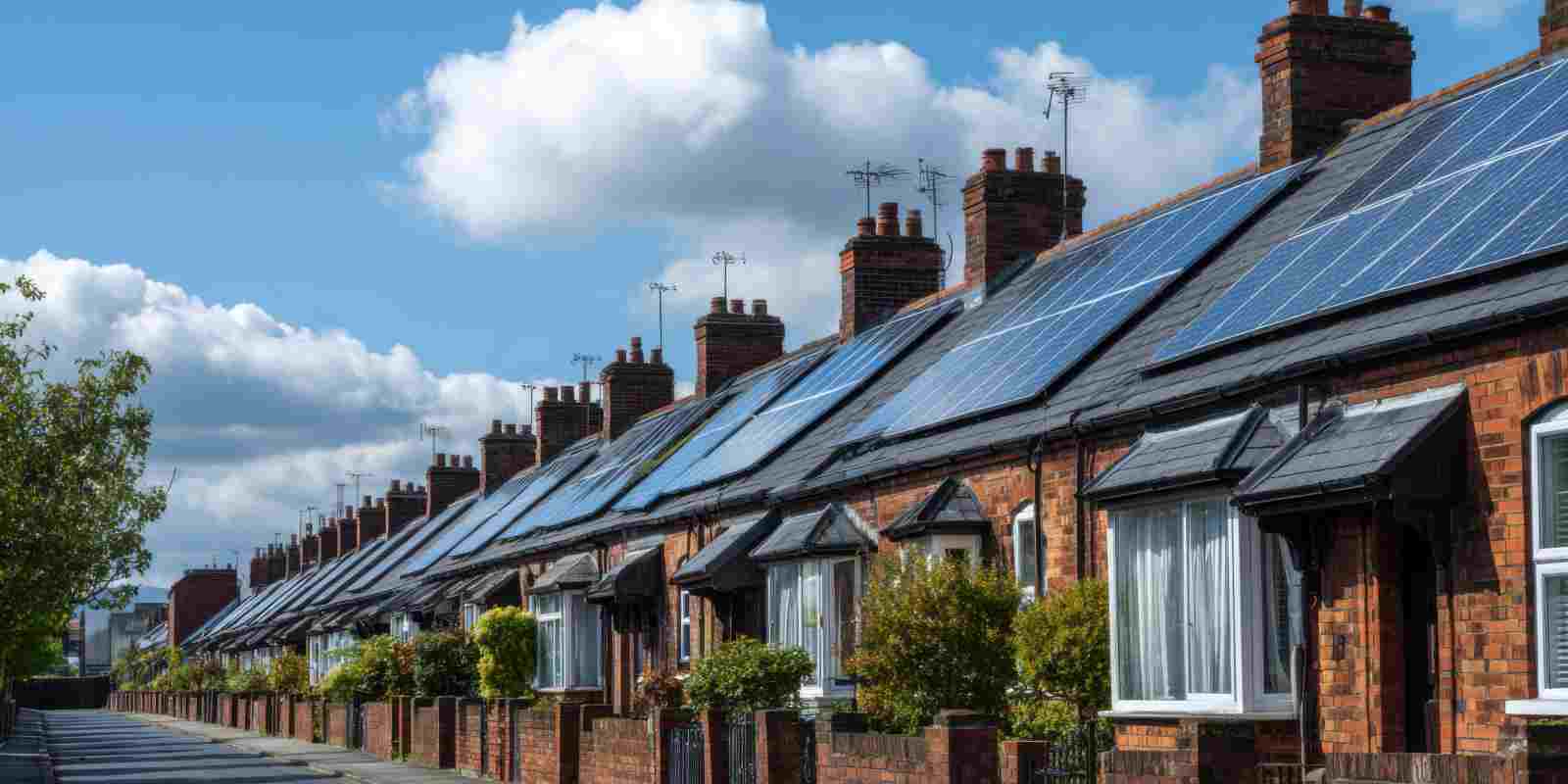
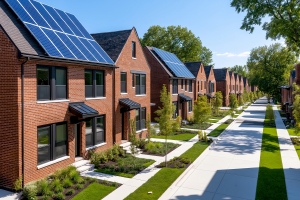
Townhome owners in Southern and Western Maryland often rule out solar panels without ever asking anyone about it. They feel the roof is too small, and they aren’t sure about the process with the architectural review committee or if attached homes are candidates for solar. Without challenging their own assumptions, they never give solar panels a real shot.
The reality is that many Maryland townhomes can carry a system that covers a serious share of their electric bill. Whether yours is one of them comes down to who legally controls the roof, how much of that roof is usable once code requirements are applied, and whether the math still works now that the federal residential credit has expired.
Who Controls the Roof on a Maryland Townhome
Many Maryland townhomes are fee simple, meaning the owner holds title to the structure, roof included, while the association governs exterior appearance and the common areas around the home. An owner in that position may have the legal standing to install a system on their own roof, subject to reasonable architectural standards.
However, Maryland Real Property Code § 2-119 only limits restrictions on the use of a roof for solar when the homeowner also owns the roof or holds the right to its exclusive use. Many communities organized as condominium property regimes (CPR) are not covered by this statute because the roofs are considered communal property controlled by the association.
If you aren’t sure if your community controls your roof, check the recorded declaration or bylaws and look for language that defines boundaries and maintenance duties for roofs or exteriors.
What Maryland Law Says About HOA Solar Restrictions
Maryland Real Property Code § 2-119, as amended by Chapter 517 of the 2025 session and effective October 1, 2025, does not allow a recorded covenant or association to place “unreasonable” restrictions on the installation of a solar collection system on a roof or exterior wall.
That statute defines “unreasonable” as a restriction that raises the installation cost by at least 5% above the initially proposed installation, or if it cuts the energy the system generates by at least 10% below what that initially proposed installation would have produced.
The statute does not apply to historic property listed in, or determined eligible for, the Maryland Register of Historic Properties. Associations also keep their authority over common areas, and they can still enforce aesthetic standards that stay inside the 5% and 10% thresholds. Requiring black frame modules or concealed conduit runs, for example, is usually fine under that test.
How Much of a Townhome Roof Is Actually Usable
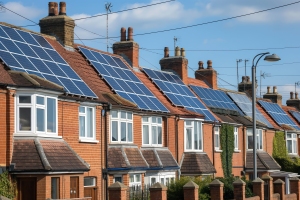
How much square footage a roof has, and how much of that space is usable for solar modules, are two different numbers.
Relevant Maryland law includes fire codes that require clear access pathways and setbacks near the ridge of the roof so crews have room to work. The dimensions vary by county and by which edition of the code a jurisdiction has adopted. On a townhome with a roof measuring 18 by 24 feet, that code can erase close to a quarter of the available area. Vent stacks and bath fan terminations chop up part of what is left, and features such as a skylight will take out more.
How the roof is oriented plays a large role in how much energy it can collect. A row of townhomes shares one roofline that runs in one direction. Rows built on an east-to-west axis give each unit a south-facing plane, which is the best case in Maryland. Rows built north to south give every unit east and west planes, which still produce, just noticeably less over a year than an equivalent south-facing plane would.
Homeowners considering a solar roof installation should check their roof’s age. Townhome rows often get re-roofed as a block, and a system installed a year ahead of a scheduled replacement means paying to pull the array off and put it back on. Find out where the roof sits in its life cycle before deciding to install solar.
Solar Economics for Townhome Owners in 2026
There are government incentives for installing solar, though some of those programs recently changed.
The federal Residential Clean Energy Credit under 26 U.S.C. § 25D was terminated for systems made after December 31, 2025. This means a system finished in 2026 or after does not qualify for the 30% credit the program used to offer.
However, Maryland itself still has programs that homeowners can use.
The Maryland Energy Administration’s Solar Access Program for income-eligible households is accepting FY27 applications from July 29, 2026 through May 31, 2027 (or sooner, if the total requested exceeds the available program budget). Rebate amounts are calculated from system size, and the formula can change each year. The program requires a participating contractor and reservation approval before installation begins.
Maryland also has a Solar Renewable Energy Certificate (SREC) market. A registered system earns one SREC for every 1,000 kilowatt-hours it produces, and those certificates can be sold to energy suppliers or handed to an aggregator that sells them in bulk. Prices move with the market, so any SREC number in a proposal is an estimate.
BeSMART Energy Efficiency Financing is a home loan program from the Maryland Department of Housing and Community Development. Terms are subject to change, so confirm the current numbers against program documents before you commit.
Net metering credits you for what your panels send back to the grid. When the array makes more than the house is using, the excess flows out and is netted against what you pull back in, so you’re billed on the difference rather than on everything you consumed.
A monthly facility charge stays on the bill no matter how much you generate. Additionally, credits that pile up beyond what you use are settled once a year rather than banked at full value. SMECO (Southern Maryland Electric Cooperative) issues that credit on April bills, and reported an average of $58.79 across 4,131 residential customers in April 2026.
Find Out What Your Townhome Can Support
At Energy Select, our team of local solar professionals can assess your townhome roof to help you determine its compatibility with solar panels. Contact us today to schedule an appointment. We’ll give you a proposal that accounts for your roof’s material, shade coverage, structural integrity, orientation, and more, so that you can make an informed choice about your energy options.
You can also get an Instant Estimate to get started fast. We Know Energy.