Utility rates in Maryland continue to increase, spurred by planned price hikes from major providers (including BGE and Pepco), inflation, and rising labor costs. To mitigate these costs, 188 solar companies in Maryland provide 7.13% of the state’s electricity, much of which is used by Maryland businesses to save on costs.
However, to save money on annual utility costs, Maryland business owners must maneuver the complex array of solar technologies, assess efficiency levels, create cost roadmaps, and compare system compatibility. Matching the technology to the business can be difficult without professional guidance.
| In This Article: Readers will learn about current solar offerings to help business owners match solar energy systems, including panels, inverters, and batteries, to their needs. Also covered are facts that business owners should know about Maryland’s natural and regulatory environments and how they could impact their solar plans. |
Why Switch to Solar Power in Maryland?
In Maryland, residents spend about 7% more on electricity than the national average. This number is not going down, with recent reports showing that residential customers of major utility providers are paying as much as $21 more per month than earlier this year. For businesses, these increases can be attributed to changing environmental policy requirements and infrastructure costs. The result is potentially thousands of dollars in unexpected energy costs per year.
For example, in 2022, Maryland passed the Climate Solutions Now Act (CSNA), which set the state’s target for greenhouse gas emissions to 60% of 2006 levels by 2031, and net-zero emissions by 2045. This places increased pressure on businesses to stay ahead of regulatory energy production changes using sustainable solar systems. This is especially true for small businesses, with nearly 1 in 4 being directly impacted by the state’s energy transition while also dealing with economic uncertainty, labor costs, inflation, and planned increases by utility providers.
Note – According to studies of small businesses, solar panel installations can save them up to 30% on monthly energy costs, with the highest savings occurring during the summer months. The size and power consumption needs of the business can impact how long it will take to break even on solar installations, but as energy costs rise, the need for these savings will grow as well.
What is a Solar Photovoltaic (PV) System?
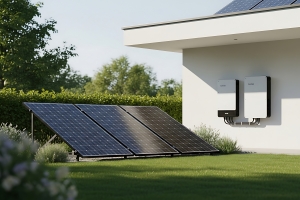
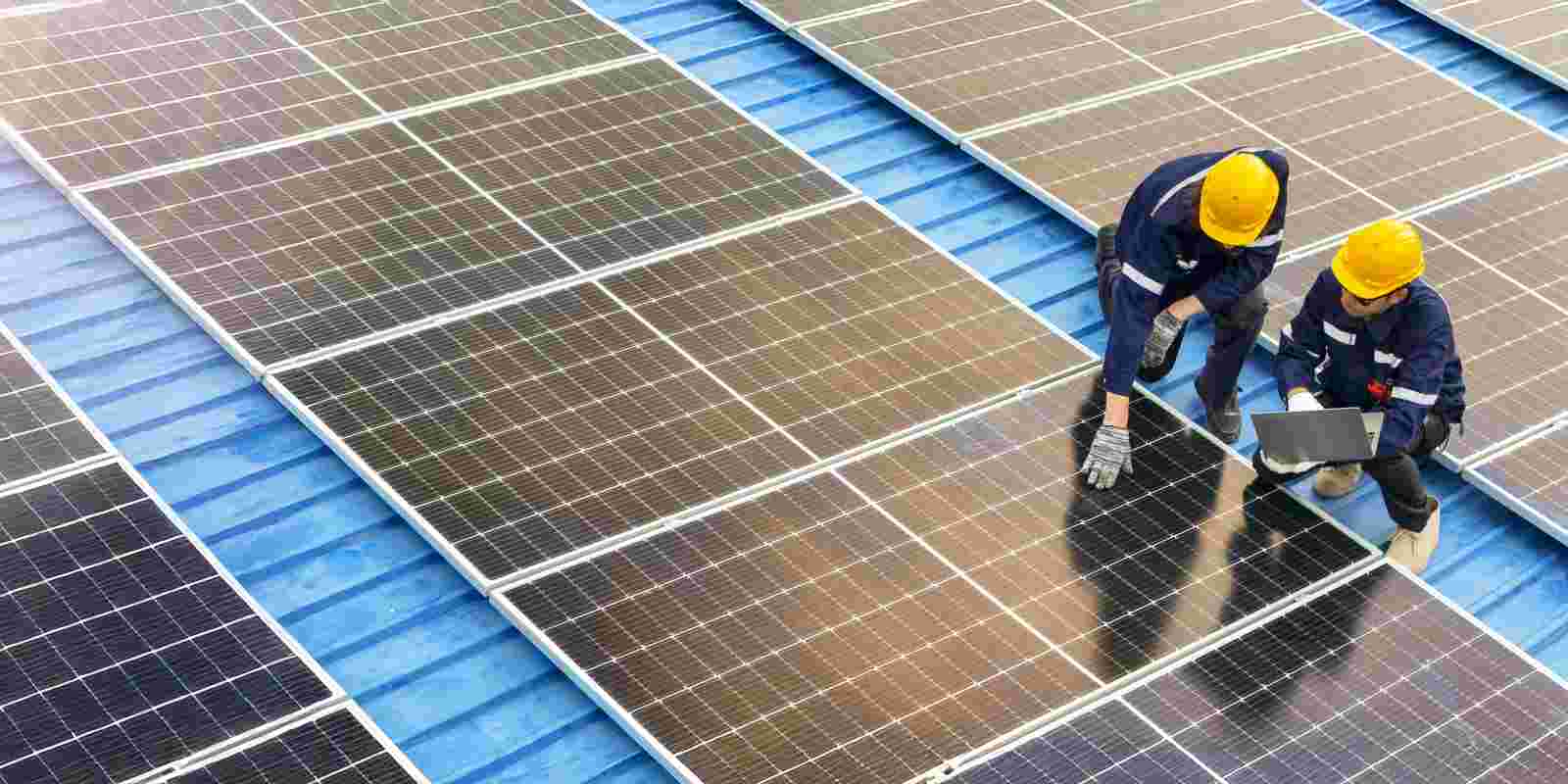
Solar photovoltaic (PV) systems are the most commonly adopted solar panels due to their reliability, low maintenance, and lack of complex parts. The electricity is produced in the solar cell, usually made of silicon, which is strung together with other cells to form a panel. Multiple panels are connected to an inverter in a configuration known as a “string.” The entire system is known as the “array.”
PV systems are commonly used in homes, but they can benefit business installations as well. Here are several possible configurations of PV systems in modern businesses:
- Thin-film PV solar systems can be adapted to nonstandard roofs, useful for commercial buildings with large, flat roofs.
- Building-integrated photovoltaics (BIPV) can absorb sunlight directly into building materials, such as windows or shingles, making them ideal for new construction. Without separate panels, businesses can save space and offset the costs of conventional installation materials in exchange for slightly lower efficiency.
- Concentrated photovoltaics (CPV) use lenses and high-efficiency solar cells to focus sunlight for maximum efficiency in exchange for higher upfront and maintenance costs. Due to the need for direct sunlight, Maryland’s cloudy weather makes these systems a less efficient choice in most situations.
The business’s budget, the orientation of its roof, and the available sunlight coverage will determine which PV system provides the best coverage. In addition to these panel types, arrays can have three types of inverters: central, micro, or power, which impact their generation efficiency and maintenance costs.
Note – See the table below for more information on inverters and their differences for businesses.
Solar Arrays Made From Other Materials
Other PV systems can be made from crystalline silicon structures in two variations: monocrystalline silicon (Mono-Si) and polycrystalline silicon (Poly-Si). The distinction is in how the PV material converts sunlight into electricity. Different materials mean different efficiency levels, installation types, and maintenance costs.
Mono-Si panels are high-efficiency systems for buildings with limited roof space, especially in visible areas, thanks to their sleek, high-quality appearance. Poly-Si arrays are lower-quality but lower-cost, requiring more space to function efficiently. They could be suited to warehouses or facilities with large roofs.
Solar Arrays With Battery Backups
Many businesses choose to combine PV systems with battery storage, giving their operations greater resilience during power outages. This grid independence is especially beneficial for businesses with a need for consistent uptime, such as data centers, hospitals, and facilities for storing medication or food.
Essential Takeaway: The terminology can be confusing, but each type of solar panel has different advantages and potential drawbacks that businesses can use to make their decision.
How to Match the Solar Technology to the Business
This chart can help business owners recognize the benefits and challenges of each technology type to find the best fit:
| Technology | Description | Pros | Cons | Use Case |
| Thin-film | Semiconductor material layers | Low weight, high heat tolerance | Space requirement, lower lifespan | Warehouse or parking garage roofs |
| Monocrystalline | Single silicon crystal | High efficiency, high lifespan, low space requirements | High cost | High-output businesses with less roof real estate |
| Polycrystalline | Multiple silicon crystals | Low cost, high reliability, high availability | Lower efficiency, lower heat resistance (compared to monocrystalline) | Large facilities with no roof constraints |
| String Inverters | Multiple panel strings route through one inverter | Cost-effective, low-maintenance | Overreliance on each panel | Uniform roof structures with consistent sunlight |
| Central Inverters | Large single inverter unit | Low cost per watt | One point of failure, high maintenance | Multi-building properties or utilities with large roofs |
| Microinverters | An inverter on each panel | Maximum energy, high scalability | High cost, high maintenance | Nonstandard roofs with shaded areas |
| Battery Storage (Li-ion) | Rechargeable off-grid solar storage | High energy density, fast charge, long life | High cost, high temperature sensitivity | Grid-dependent businesses with an always-on requirement |
| Battery Storage (Flow) | Liquid electrolytes store energy in tanks | Long life, high scalability | High cost, high space required | Businesses with long discharge needs, such as industrial facilities |
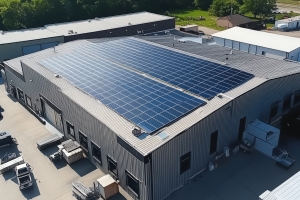
Essential Takeaway: Matching the type of solar panel, material, inverter type, and more to the business’s physical structures and energy needs can be complicated. Consulting local solar installers can help demystify these requirements and match the technology to your exact needs.
Book Your Consultation for Maryland Solar Panels
Energy Select provides businesses with complete solutions for Maryland solar panels that improve their financial and environmental outlooks. Our focus is on matching energy production and conservation strategies to the business’s exact needs, including available roof space, building orientation, budget, and more. These materials and technologies can vary in upfront costs, maintenance requirements, efficiency, and more, so businesses must take care to match their solar panels to their current limitations and long-term goals.
Request a quote from our team to get an instant estimate on solar power technology and learn how to keep your business grid-independent with our state-of-the-art solar solutions.