

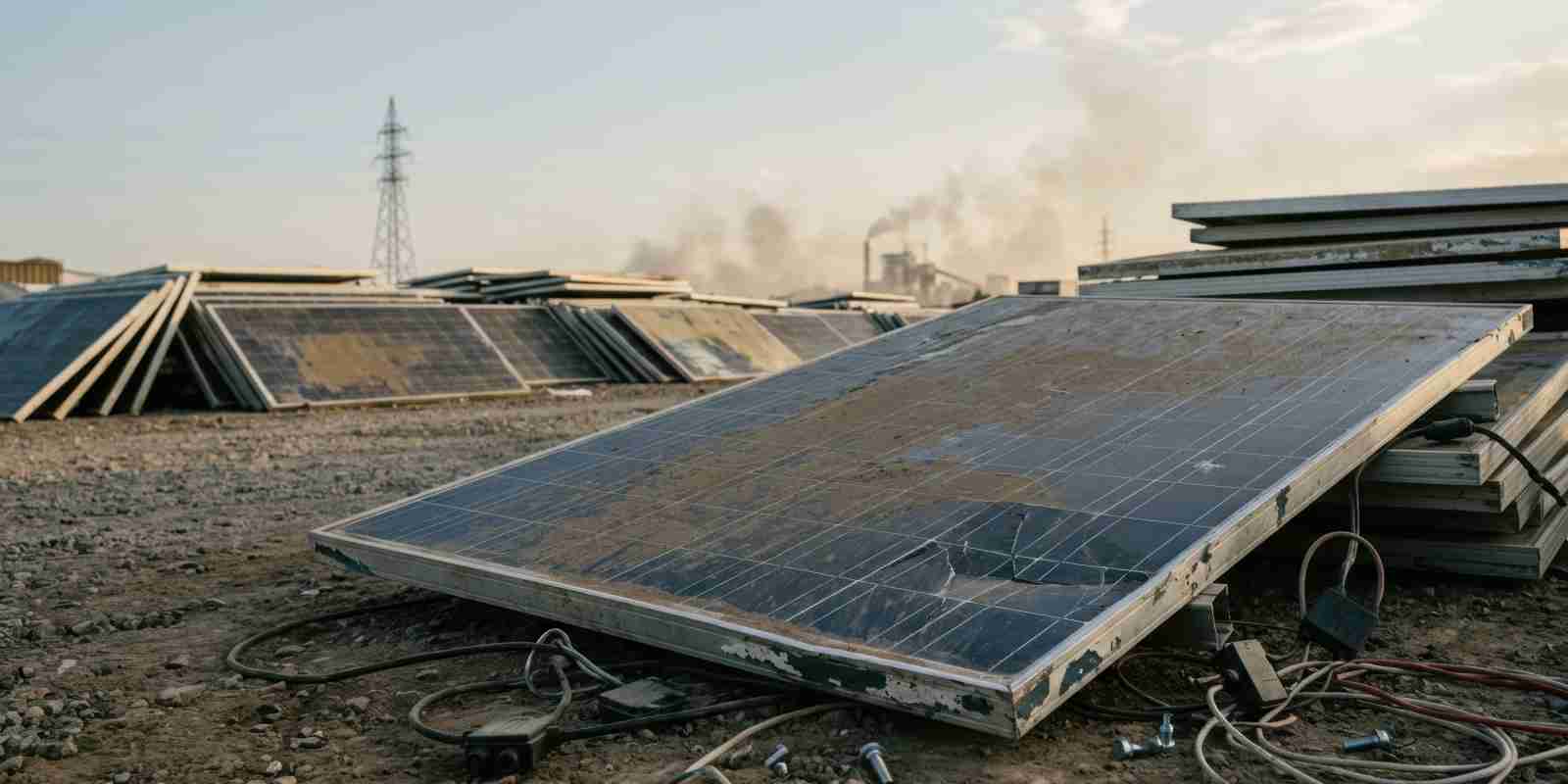
A 25-year manufacturer warranty is the industry norm for residential solar panels, according to the National Laboratory of the Rockies (NLR), formerly the National Renewable Energy Laboratory (NREL). A Maryland homeowner planning for solar panel end-of-life faces two decisions. Solar panel decommissioning means taking the array down and closing out the utility paperwork, and the owner then picks solar panel recycling, resale, or landfill disposal.
Signs a System Has Reached the End of Its Useful Life
Output from a typical panel slips by roughly 0.5% a year, and NLR puts the median failure rate near five panels per 10,000 each year between 2000 and 2015. Twenty years in, an array degrading at that pace still produces about 90% of its first-year capacity, which on its own is not grounds for replacement.
Panels may be removed due to issues such as damage from inclement weather or the installation of a new roof. Hail can fracture a module’s tempered front glass, and moisture that gets past a failed edge seal can cause the laminated layers to separate. For a reroof, crews handle removal and reinstallation of the existing panels using the same wiring and racking steps as a full decommissioning.
One failing cell can run hot and lower a panel’s production, which shows up in monitoring data. To separate ordinary aging from one bad part, line up each month’s numbers against the same month in earlier years and allow for weather. Owners who keep up with performance tracking already have that record.
Inverter warranties come in numerous forms (e.g., 10, 12, 20, 25 years), and in a 2018 maintenance guide, researchers from the National Laboratory of the Rockies (the NLR, which was called the National Renewable Energy Laboratory, NREL, at the time) and Sandia National Laboratories ranked those failures among the most frequent sources of lost production. If output falls to zero on a sunny day, start with the unit’s status screen or call the installer.
Three Stages of a Residential Decommissioning Job
Every decommissioning job runs through three stages: the electrical shutdown, the roof work, and the utility paperwork. Get all three spelled out in the written removal quote.
The electrical shutdown happens first, since live conductors carry a shock hazard until each connection is broken. Light striking a panel produces voltage, so the direct current (DC) runs between modules, which stay energized all day even with the alternating current (AC) side switched off. Depending on the type of system, a licensed electrician may open each circuit, disconnect the string plugs at the array, and pull out the inverter and conduit.
The roof work covers every penetration from the racking mounts, and each one needs proper sealing or flashing. Pulling lag bolts from aging asphalt shingles can fracture the material around them, so timing the removal with a planned reroof saves the owner from paying for patching twice.
The utility paperwork is the final stage. Under Maryland’s standard interconnection agreement, in the version Potomac Edison publishes, a customer needs written utility approval before changing a system that could cause an adverse system impact and must give 30 days’ written notice before ending the agreement. Southern Maryland Electric Cooperative (SMECO) members should confirm the same requirements with the co-op.
Materials Recyclers Recover from Old Solar Panels

Glass accounts for roughly three-quarters of a crystalline silicon module by weight, per the U.S. Environmental Protection Agency (EPA), and recovering glass is familiar work for existing recyclers, the agency notes. The aluminum frame, copper wiring, and plastic junction box also fall on its easy-to-reclaim list. In its 2022 end-of-life action plan, the U.S. Department of Energy (DOE) estimated that current methods can recycle 95% of module materials and classified 99% of them as non-hazardous.
Silicon cells and their printed silver contacts are harder to get back because they are laminated inside a polymer encapsulant. Pulling those bonded layers apart costs money, so recyclers using standard methods may recover the glass, aluminum, and copper and incinerate what remains, according to the EPA. Recyclers lose much of the value at that step, since silicon, silver, and copper together account for about two-thirds of a silicon panel’s material worth, according to Chemical & Engineering News.
Solar Panel Recycling Options in Maryland
When Johns Hopkins researchers summarized the findings of the Maryland Commission on Climate Change’s solar working group in January 2025, the state had no dedicated solar recyclers. Recycling solar panels from a local home means trucking them to an out-of-state processor at the owner’s expense. The working group ranked reuse ahead of remanufacturing and material recovery and argued against defaulting to the landfill.
The EPA said in October 2023 that it intended to propose placing solar panels under its universal waste rules, which carry lighter handling requirements. The agency still lists the proposal as planned and confirms that some retired panels contain enough lead to count as hazardous.
Per current EPA guidance, whoever generates the waste makes that determination, and the agency points homeowners toward state or local recycling offices. Before removal day, get the name of the party making that call, and the recycler taking the panels, in writing.
Resale is one option for old solar panels, provided they come down undamaged and still producing. Researchers with the International Energy Agency’s Photovoltaic Power Systems Programme note that marketplaces already exist for qualifying used panels. With output falling about 0.5% a year, a 10-year-old array has far more life left for a second owner than a 30-year-old one.
End-of-Life Costs for Maryland Homeowners
In its 2022 plan, DOE pegged recycling at $15 to $45 per module and solar panel disposal at a landfill at $1 to $5, before transportation. Across a 24-panel home system, that works out to roughly $360 to $1,080 in processing fees.
Budget separately for the electrician and for roof repairs at each mount. DOE called the economics unfavorable to recycling when it published the plan, so sustainable solar panel disposal generally costs owners and installers extra. The department’s 2030 target is $3 per module, but a homeowner retiring a system sooner should work from a current quote.
A buyer can settle much of this before signing by planning around the full solar panel lifecycle. Ask the installer who handles removal if the roof needs replacing down the road, and find out whether the module manufacturer runs a take-back program for an end-of-life solar system.
Keep One Local Team on Your System from Installation to Removal
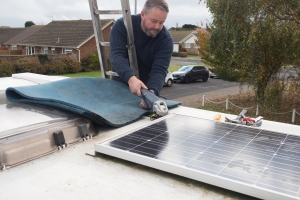
Energy Select installs and services every system with its own crews in Southern and Western Maryland. The same local team that mounts your array can take it down for a reroof or retire it once production no longer justifies keeping it. With your Customer Relationship Manager and the project app, you can follow production for the life of the system.
If you replace the array, you can add solar battery backup at the same time, sized to how your household uses power now. Request a Quote to plan a removal, a reinstallation, or a new system with a local Energy Advisor.